Saturday, September 27, 2008

Apocalypse #14, Architecture #32

It is one of the many grotesque ironies of our acceptance of technological totalitarianism that its most eager advocates among architects and all other categories of designer do not realize that they are committing themselves to voluntary castration. The artificial obsolescence syndrome has much deeper implication than the petty larceny of depreciation without service. It implies hatred of designed environment, an inability to love the things that make an identification of man and world possible. The inevitable and totally logical climax of this alienation by obsolescence is the spending of billions of national capital on a moon landing. Man's future in a space suit on a planet where neither organisms nor shapes nor continuity in time can be maintained will mark the final victory of the technocrat over man.

Sibyl Moholy–Nagy, "The Invisibility of Design" (Autumn 1962)

Wednesday, September 24, 2008

Manhattan #37


New York in the Future, Ideal Scheme, R.M. Bennett and G. Hicks (1940)

Tuesday, September 23, 2008

The Iron Horse #5, War #10


Farmville, Virginia, vicinity. High bridge of the South Side Railroad across the Appomattox. Two plates from left and right half of stereograph pair. Photographer, Timothy H. O'Sullivan (April 1865)

Thursday, September 11, 2008

Anniverseries #10, Manhattan #36, Architecture 31


The World Trade Center towers under construction
Minoru Yamasaki and Associates (1966-1973, photographed October 20, 1970)

Wednesday, September 10, 2008

Order of the Universe #14

The world is too much with us; late and soon,
Getting and spending, we lay waste our powers;
Little we see in Nature that is ours;
We have given our hearts away, a sordid boon!
This Sea that bares her bosom to the moon;
The winds that will be howling at all hours,
And are up-gathered now like sleeping flowers,
For this, for everything, we are out of tune;
It moves us not.—Great God! I'd rather be
A pagan suckled in a creed outworn;
So might I, standing on this pleasant lea,
Have glimpses that would make me less forlorn;
Have sight of Proteus rising from the sea;
Or hear old Triton blow his wreathèd horn.


William Wordsworth

Sunday, September 07, 2008

The Automobile #17, Panorama #8


The handwritten caption reads: “Largest group in the world, Buick Employe's”

The painted banner on the factory reads “BUICK MOTOR CO. LARGEST AUTOMOBILE MANUFACTURERS IN THE WORLD. ANNUAL CAPACITY 40,000 CARS.

(1913)

Wednesday, September 03, 2008

America #42

Given an old culture in ruins, and a new culture in vacuo, this externalizing of interest, this ruthless exploitation of the physical environment was, it would seem, inevitable. Protestantism, science, invention, political democracy, all of these institutions denied the old value; all of them, by denial or by precept or by actual absorption, further the new activities. Thus in America the new order of Europe came quickly into being. If the nineteenth century found us more raw and rude, it was not because we had settled in a new territory; it was rather because our minds were not buoyed up by all those memorials of a great past that floated over the surface of Europe—a movement carried on by people incapable of sharing or continuing a past. It was to America that the outcast European turned, without a Moses to guide them, to wander in the wilderness; and here they have remained in exile, not without an occasional glimpse, perhaps, of the promised land.

Lewis Mumford, “The Origin of the American Mind” in The Golden Day: A Study in American Experience and Culture (1926)

Thursday, August 28, 2008

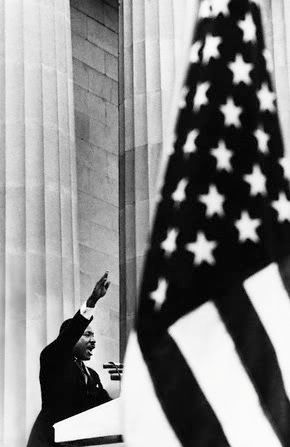
Anniverseries #9, America #41, Dead Presidents #41


Martin Luther King, Jr. delivers the "I Have a Dream" speech on the steps of the Lincoln Memorial, Washington, D.C. (August 28, 1963)

Tuesday, August 26, 2008

Auden #19, Πολιτικά #2

De Tocqueville stands out as one of the noblest examples of an attitude which may be called the Counter-Revolution. This must not be confused with Reaction, which refuses to recognize the just element in the Revolution and wishes to regard it as a simple rebellion. The Counter-Revolutionary has no wish to return to the condition which preceded the outbreak of revolution; he wishes rather to save the revolution from failure through the inevitable over-emphasis and over simplification of the revolutionary party.

The central issue of the world revolution at present in progress is the right of every human body to the food, light, housing, medical attention, and so forth necessary for health. Its symbols are the naked anonymous baby and the tomb of the Unknown Soldier. The body knows nothing of freedom, only of necessities, and these are the same for all bodies. Hence the tendency of the revolutionary party in concentrating on this one goal to deny all liberty and all minority rights. In so far as we are bodies, we are or ought to be revolutionaries; in so far, however, as we are also souls and minds, we are ought to be counter- revolutionaries, and in our struggle, the books of De Tocqueville belong, together with Thucydides, the Seventh Epistle of Plato, and the plays of Shakespeare, in the small group of the indispensable.


Review of The Recollections of Alexis de Tocqueville, in The Nation (April 8, 1950)

Thursday, August 21, 2008

In Memoriam #12, Cinema #39

Manny Farber

(1917-2008)

Visual Arts 188 exam from taught by Farber at the University of California, San Diego [early 1970s]


OBJECTIVE QUESTIONS

1. How many characters does Herr R. bludgeon when he runs amok?

2. Who are the characters Herr R. bludgeons when he runs amok?

3. Rank the following films in terms of the amount of objects likely to be found in a scene from their movies: a. Resnais' MURIEL or any of his film; b. Jancso's RED PSALM; c. Duras' DESTROY, SHE SAID.

4. How much (much, some, little, or none) camera movement is in the following films? a. DESTROY, SHE SAID; b. Godard & Gorin's LETTER TO JANE; c. Fassbinder's WHY DOES HERR R., d. Snow's LA REGION CENTRALE; e. RED PSALM; f. MURIEL; g. Gehr's SERENE VELOCITY.

5. In what film does a camera run amok in a college classroom?

6. Every director in this course uses a long, continuous take in one form or another. One definition of the long take: a single piece of unedited film, which may or may not constitute an entire sequence. Identify the director who uses the long take to:

a. Suggest impersonal, all-over-the-body sexuality;

b. Create a ritual effect of religious mortification in a grassy land or hellscape;

c. Build a comic-strip essay about consumerism and housewife prostitutes in a combination nursery-brothel;

d. Build a picture of the stupefying daily rituals experienced by a family's breadwinner

7. A truly radical formalist makes a deep cut into film practice with at least one inventive maneuver, a way of assembling the elements of film that deeply affects his or her contemporaries. Identify the director.

a. He's adamantly against applied soundtracks. He did one film against the murmur of traffic, which supplies the tonal variations given to other films by a musical score. His is a purist's argument: if you can add a juke box in the background, why not add ten other layers of sound?

b. Still light years more emancipated than the erotic revelations of LAST TANGO IN PARIS. But that's not all he dared to do. By dispensing with tension and development, and using real time, he created an alternative to traditional movie language.

c. He's changed the image from fronted to engulfing. Compared to his movie, where the spectator is in a planetarium situation, engulfed by the dynamics of a very controlled camera, the spectator in other films is in a theatrical situation, removed at some distance from an event that is played toward him, billboard-fashion.

d. The director is exploring how far you can take a movie into becalmed quiescent territory. By emphasizing sensuous tactility (with tempered movements, mannered voices), this anti-aggression director questions the amounts of noise, zap, excitement that a movie needs.

8. A five-part question on the role of women: assign the correct director's name to the following treatments of women in these films:

a. They're usually romantic, anxiety-ridden, and fluttery; for instance, the glimpses of a darting woman in short intense moments, as though seen through a prism. They have an incandescent, luminous, feverish quality. The director emphasizes the plasticity of bodily and facial movements and is very sharp on the woman’s precise position within a situation that smacks of soap opera.

b. He stereotypes his peasants. Their arms often crossed demurely over their breasts, his women move within a divorced and simplistic treatment that sexually humiliates them. They’re always pretty and virginal, moving lyrically and silently through the cruel landscape.

c. Woman is the brainier, testier, wittier, and more active gender. She expresses herself in an incessant nasal drawl, taunting any males in the vicinity.

d. She is always stoical, right-minded, even the buxom-blonde in a lemonade stall in the railroad station – always a pure luminous person. There is never any sense of great contact, emotion, or conflict in her low-key, cooled-off effect. The stoicism comes partly from the sense of a figure pushed to the back of the shot by an angular feeling in the composition.

e. The Woman often seems sentimental, woebegone: a neutralized inexpressive face is supposed to keep your attention dispersed over the image of her environment. The dumb expression, the lacrymosity inherent in the tepid handling of a dish, a dress, or a word suggests a woman trivialized by her director.


9. Identify the movies which provide posterity with the following great lines:


a. “This is the face that says it knows a lot about something.”

b. “How many breakfasts in the Cafe Kroner?”

c. “I have nothing to say and my students sleep in class.”

d. “We’ll be leaving the neighborhood soon. My husband’s getting a promotion.”

e. “He’s going to come toward me, he’s going to take me by the shoulders, he’s going to kiss me…he’ll kiss me…and I’ll be lost!”

f. “You were made to the measure of my body.”

g. “No one’s ever crossed our family before.”


10. Draw the room in WAVELENGTH, the way it looks from the camera’s original setting; include (and label for clarity) all the important objects.


ESSAY QUESTIONS

1. There are there premises of this Radical Film course: (1) each movie is an example of a sustained austere form, (2) each director has discovered an image that evokes philosophical thought about the categories of being, and (3) each director has pushed at least one stylistic concern that has influenced or changed the working style of his contemporaries. How does Warhol, the most masked and cunningly defensive director in covering his tracks, answer all the requisites of this course? Fifty words more or less, and cover each premise.


2. Fassbinder and Warhol both use groups of people, long takes, and blatant color; yet in one the tensions within a group are emphasized, while the other exploits the freedom and anarchy within a group. What in their films shows this difference?


3. Michael Snow and Ernie Gehr are often called structuralists and minimalists because the restrict themselves to a barren empty space and build their films out of the raw material of this space. One way or another they try for a fresh perception. Show how by discussing in depth at least one film of each director. Keep in mind that this is a question about the development or manipulation of a perception.


4. This is a question about the philosophic meaning behind the movies in this course. WAVELENGTH (Mike Snow’s movie about a forty-five minute zoom from one end of a room to another) is a confrontation of real fact and movie fact, facing a spectator with an actual chair and the illusion of one, a real girl making a phone call and the “ghost” or filmic image of a girl transparently making a phone call. The verbal jousting in Warhol’s MY HUSTLER, the totally random life enclosed within the single frame of a small bathroom, makes you think of the difference between the most mundane, ordinary reality and the aesthetic reality of an abstracted single-frame movie. Using one or two or three sentences for each director, what is the metaphysical meaning behind Resnais’ MURIEL, any of the Straub films shown here, and Godard’s TWO OR THREE THINGS. (If you don’t know the answer to any part of this question, substitute another director studied in this course.)

[originally published in the May-Jun 1975 issue of Film Comment]

WCW #7

Words are the burden of poems, poems are made of words

William Carlos Williams, typescript for Paterson 6

Monday, June 23, 2008

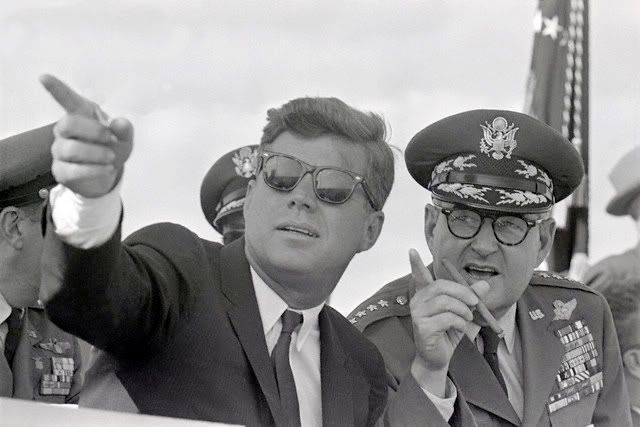
Diptych #10, Dead Presidents #40, Scenes from a Life #19


Top: President John F. Kennedy and Air Force Union of Staff General Curtis LeMay point at a fireworks display staged for the president. (May 4, 1962)

Bottom: Original caption: Swapping his Air Force uniform for a bright sport shirt, General Curtis LeMay, Head of the U. S. Strategic Air Command, sharpens his shooting eye with some target practice at the Marine Base at Quantico, Virginia. LeMay sandwiched in the shooting session during the three-day conference on Defense Matters, at the base. (June 17, 1957)

Friday, June 20, 2008

Archaeology of the Poster #7


Harry Kellar unleashes Pandora's Box (c. 1894)

Wednesday, June 18, 2008

In Memoriam #11, Cinema #38

Cyd Charisse

(1922-2008)


Sequence from Party Girl d: Nicholas Ray (1958)

Tuesday, June 17, 2008

Scenes from a Life #18, Age of Print #8, The Automobile #16


The Los Angeles Times reports the death of Ernie Kovacs (January 13, 1962)

Monday, June 16, 2008

Architecture #30, Food #12

To me, and to all the cultivated people, ornament does not increase the pleasures of life. If I want to eat a piece of gingerbread I will choose one that is completely plain and not a piece which represents a baby in arms of a horserider, a piece which is covered over and over again with decoration. The man of the fifteenth century would not understand me. But modern people will. The supporter of ornament believes that the urge for simplicity is equivalent to self-denial. No, dear professor from the College of Applied Arts, I am not denying myself! To me, it tastes better this way. The dishes of the past centuries which used decoration make the peacocks, pheasants and lobsters appear more appetizing produce the opposite effect on me. I look on such a culinary display with horror when I think of having to eat these stuffed animal corpses. I eat roast beef.

Adolf Loos, “Ornament and Crime” (1908)

Thursday, June 12, 2008

Age of Print #7, Architecture #29


Frontispiece, Pioneers of the Modern Movement (Faber & Faber, 1936)

Wednesday, June 11, 2008

Art #17, Order of the Universe #13

No critic of experience will return to a discussion of the terms “romanticism” and “classicism” with anything but extreme reluctance; no subject has provoked so much but extreme resistance; no subject has provoked so much weary logomachy since the Scholastics argued themselves out on the question of nominalism. I only take up the discussion again (eating my own words in the process) because I think that Surrealism has settled it. So long as romanticism and classicism were considered as alternative attitudes, rival camps, professions of faith, an interminable struggle was in prospect, with the critics as profiteers. But what in effect Surrealism claims to do is resolve the conflict—not, as I formerly hoped, by establishing a synthesis which I was prepared to call “reason” or “humanism”—but by liquidating classicism, by showing its complete irrelevance, its anaesthetic effect, its contradiction of the creative impulse. Classicism, let it be stated without further preface, represents for us now, and has always represented, the forces of oppression. Classicism is the intellectual counterpart of political tyranny. It was so in the ancient world and in the medieval empires; it was renewed to express the dictatorships of the Renaissance and has ever since been the official creed of capitalism. Wherever the blood of martyrs stains the ground, there you will find a doric column or perhaps a statue of Minerva.

Herbert Read, introduction, Surrealism (1936)

Friday, May 30, 2008

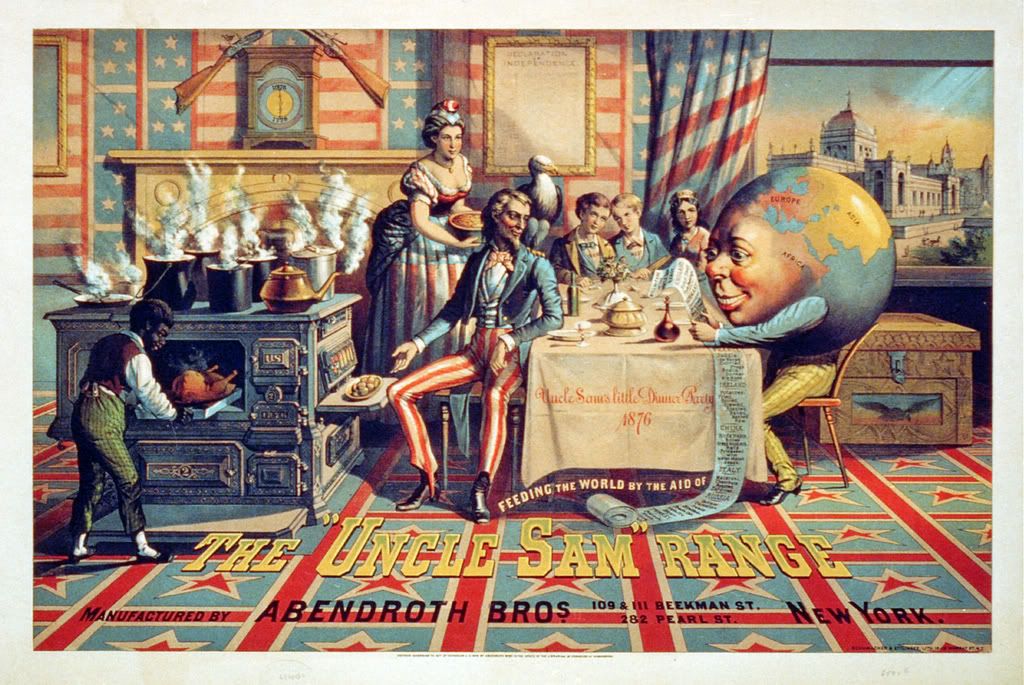
America #40, Annals of Advertising #7, Foreign Lands #26, Food #11


Advertisement for the "Uncle Sam" Range, Manufactured by Abendroth Bros., New York City (1876)

The menu in the world's hand reads:

BILL OF FARE
For the Uncle Sam Range.

ENGLAND
Roast Beef
Plum Pudding

GERMANY
Sausages
[illegible]
Sour Cream

FRANCE
Saddle de Horse
Curried Frogs
Snails
Donkey a la Mode

IRELAND
Potatoes
Fried
Boiled
Stewed
Roasted
Baked
Mashed
Raw

CHINA
Birds Nests
Boiled Grasshoppers
Rats Fricassed with Watermelon Seeds

RUSSIA
Tallow
Candles
Seals Blubber
Train Oil
White Bear

Tuesday, May 27, 2008

Word of the Day #25

Stuccatori