Book Titles Without Context #13, Food #17
Summa lacticiniorum
Pantaleone of Confienza (1477)


All culinary tasks should be performed with reverential love, don’t you think so? To say that a cook must possess the requisite outfit of a culinary skill and temperament—that is hardly more than saying that a soldier must appear in uniform. You can have a bad soldier in uniform. The true cook must have not only those externals, but a large dose of general worldly experience. He is the perfect blend, the only perfect blend, of artist and philosopher. He knows his worth: he holds in his palm the happiness of mankind, the welfare of generations yet unborn.
Norman Douglas, South Wind (1917)
The tragedy of English cooking is that “plain” cooking cannot be entrusted to “plain” cooks.
Countess Morphy, English Recipes (1935)
[F]ood and wine—...the formalization of gastro-sensory pleasure—must be an essential aspect of the whole life, in which the sensuous-sensual-spiritual elements are so intimately interwoven that the incomplete exploitation of any one can only result in the imperfect opening of the great flower, symbol of the ultimate perfection which is understanding, when all things fall into place...
Richard Olney, Simple French Cooking (1974)
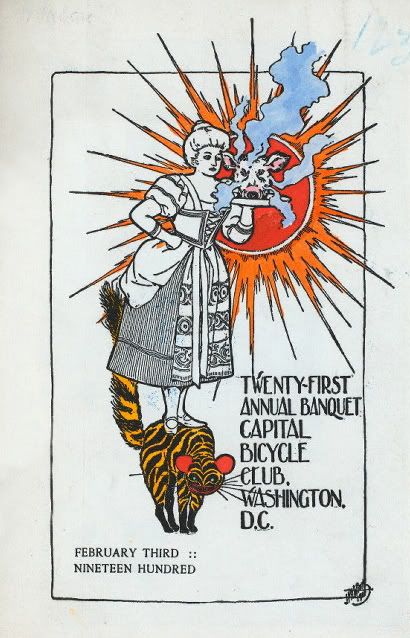
Twenty-First Annual Capital Bicycle Club Banquet dinner menu. (February 3, 1900)
To me, and to all the cultivated people, ornament does not increase the pleasures of life. If I want to eat a piece of gingerbread I will choose one that is completely plain and not a piece which represents a baby in arms of a horserider, a piece which is covered over and over again with decoration. The man of the fifteenth century would not understand me. But modern people will. The supporter of ornament believes that the urge for simplicity is equivalent to self-denial. No, dear professor from the College of Applied Arts, I am not denying myself! To me, it tastes better this way. The dishes of the past centuries which used decoration make the peacocks, pheasants and lobsters appear more appetizing produce the opposite effect on me. I look on such a culinary display with horror when I think of having to eat these stuffed animal corpses. I eat roast beef.
Adolf Loos, “Ornament and Crime” (1908)
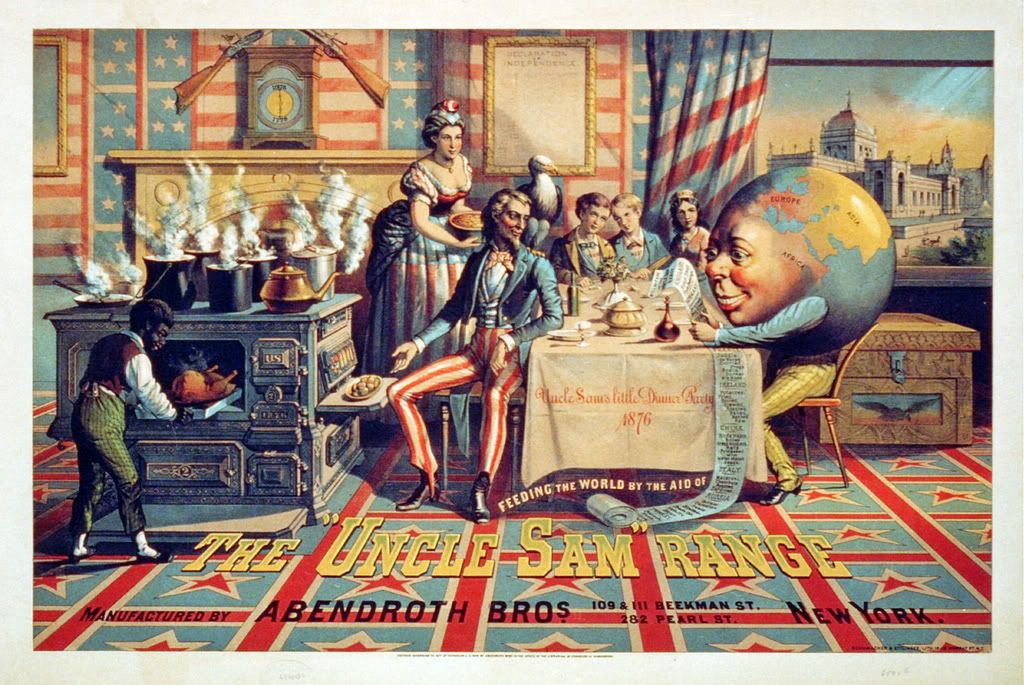
Advertisement for the "Uncle Sam" Range, Manufactured by Abendroth Bros., New York City (1876)
The menu in the world's hand reads:
BILL OF FARE
For the Uncle Sam Range.
ENGLAND
Roast Beef
Plum Pudding
GERMANY
Sausages
[illegible]
Sour Cream
FRANCE
Saddle de Horse
Curried Frogs
Snails
Donkey a la Mode
IRELAND
Potatoes
Fried
Boiled
Stewed
Roasted
Baked
Mashed
Raw
CHINA
Birds Nests
Boiled Grasshoppers
Rats Fricassed with Watermelon Seeds
RUSSIA
Tallow
Candles
Seals Blubber
Train Oil
White Bear
On devient cuisinier mais on naît rôtisseur.
Brillat-Savarin, Aphorism No. XV
On devient ingénieur, mais on naît architecte.
Auguste Perret, Aphorism No. I
It is no accident that the central rite of the Christian religion, its symbol for agape, love untainted by selfish desire or self-projection, should be the act of eating bread and drinking wine. For such a symbol, a sexual rite would never do. In the first place, since it presupposes two different sexes, it divides as well as unites; in the second, it is not intrinsically selfish enough. Though it is necessary to the survival of the race, the sexual act is not necessary to the survival of the individual so that, even at its crudest, it contains an element of giving. Eating, on the other hand is a pure act of taking. Only the absolutely necessary and absolutely self-regarding can stand as a symbol for its opposite, the absolutely voluntary and self-forgetful. From watching the way in which a person eats, one can learn a great deal about the way in which he loves himself and, consequently, about the way he will probably love or hate his neighbor. The behavior towards others of the gobbler will be different from that of the pecker, of the person who eats his titbit first from the person who leaves his to the last.
“The Kitchen of Life,” introduction to M.F.K. Fisher’s The Art of Eating (1963)
Never would it occur to a child that a sheep, a pig, a cow or a chicken was good to eat, while, like Milton’s Adam, he would eagerly make a meal off fruit, nuts, thyme, mint, peas and broad beans which penetrate further and stimulate not only the appetite but other vague and deep nostalgias. We are closer to the Vegetable Kingdom than we know; is it not for man alone that mint, thyme, sage, and rosemary exhale “crush me and eat me!”—for us that opium poppy, coffee-berry, tea-plant and vine perfect themselves? Their aim is to be absorbed by us, even if it can only be achieved by attaching themselves to roast mutton.
Cyril Connolly, The Unquiet Grave
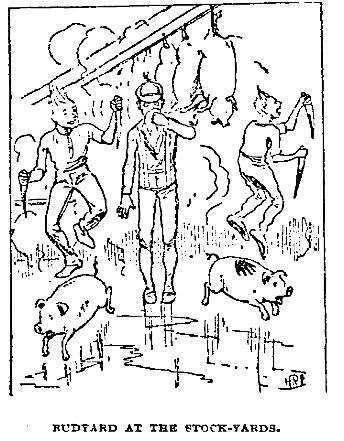
Illustration accompanying Rudyard Kipling's essay on Chicago, Chicago Tribune, Februry 8, 1891
A dreary old cliché has it that “one should eat to live and not live to eat.” It is typical that this imbecile concept, a deliberately fruitless paradox born of the puritan mind, should deny sensuous reaction at either pole, and it is fortunate that neither pole really exists, for man is incapable of being either altogether dumbly bestial or altogether dumbly “mental.”
Richard Olney
Wherefore do ye spend money for that which is not bread? and your labour for that which satisfieth not? hearken diligently unto me, and eat ye that which is good, and let your soul delight itself in fatness.
Isaiah 55:2
The symbol of Turkish cuisine is the meatball a dish which, as we all know, can be a perfection or an abortion and thus is generally regarded with suspicion, as is Bologna mortadella in London: in English, boloney is another word for rubbish.
Aldo Buzzi, "Journey to the Land of the Flies"
