Showing posts with label America. Show all posts

Tuesday, June 29, 2010

America #55

[T]he only people for me are the mad ones, the ones who are mad to live, mad to talk, mad to be saved, desirous of everything at the same time, the ones who never yawn or say a commonplace thing, but burn, burn, burn like fabulous yellow roman candles exploding like spiders across the stars...

Jack Kerouac, On the Road (1951/1957)

Wednesday, May 05, 2010

America #54

May it not be that we are shouting at Mr. [Henry] Ford because he has done us the inconvenience of revealing some of the American character a little too baldly? Is our indignation like that of the man making faces at himself in a mirror?

The first fact about Mr. Ford is that he is a very rich man. Whatever he says is therefore sure of a hearing in America. We have always acted instinctively on the theory that golden thoughts flow in a continuous stream from the minds of millionaires. Their ideas about religion, education, morality, and international politics carry weight out of all proportion to their intrinsic importance; and though we have not admitted that riches make wisdom, we have always assumed that they deserve publicity.

This automatic obeisance to wealth is complicated by our notions of success. We Americans have little faith in special knowledge, and only with the greatest difficulty is the idea being forced upon us that not every man is capable of doing every job. But Mr. Ford belongs to the traditions of self-made men, to that primitive Americanism which has held the theory that a successful manufacturer could turn his hand with equal success to every other occupation. ... Mr. Ford is neither a crank nor a freak; he is merely the logical exponent of American prejudices about wealth and success.

But Mr. Ford reveals more of us than this. He reflects our touching belief that the world is like ourselves. His attitude to the “boy in the trenches” is of a piece with his attitude to the boys in the Ford plant, kindly, fatherly, and certain that Mr. Ford knows what is best. His restless energy and success appear as a jolly meddlesomeness. He gives his boys good wages and holds them to good morals. He is prepared to do like for the boys in Flanders and around Monastir. Why shouldn't success in Detroit assure success in front of Bagdad? [sic] If Mr. Ford is unable to remember all men are not made in his own image, it is not strange. Have Americans ever remembered it? Has our attitude towards the old world ever assumed that Europe was anything but a laborious effort to imitate us?

Walter Lippman, “A Little Child Shall Lead Them” (December 4, 1915)

Thursday, December 10, 2009

America #53

To an Englishman landing upon your shores for the first time, travelling for hundreds of miles through strings of great and well-ordered cities, seeing your enormous actual, and almost infinite potential, wealth in all commodities, and in the energy and ability which turn wealth to account, there is something sublime in the vista of the future. Do not suppose that I am pandering to what is commonly understood by national pride. I cannot say that I am in the slightest degree impressed by your bigness, or your material resources, as such. Size is not grandeur, and territory does not make a nation. The great issue, about which hangs a true sublimity, and the terror of overhanging fate, is what are you going to do with all these things? What is to be the end to which these are to be the means? You are making a novel experiment in politics on the greatest scale which the world has yet seen. Forty millions at your first centenary, it is reasonably to be expected that, at the second, these states will be occupied by two hundred millions of English-speaking people, spread over an area as large as that of Europe, and with, climates and interests as diverse as those of Spain and Scandinavia, England and Russia. You and your descendants have to ascertain whether this great mass will hold together under the forms of a republic, and the despotic reality of universal suffrage; whether state rights will hold out against centralisation, without separation; whether centralisation will get the better, without actual or disguised monarchy; whether shifting corruption is better than a permanent bureaucracy; and as population thickens in your great cities, and the pressure of want is felt, the gaunt spectre of pauperism will stalk among you, and communism and socialism will claim to be heard. Truly America has a great future before her; great in toil, in care, and in responsibility; great in true glory if she be guided in wisdom and righteousness; great in shame if she fail.

Thomas H. Huxley, American Addresses (1877)

Thursday, October 08, 2009

America #52, Time #20

It's all very well for you to look as if, since you've had no past, you're going in, as the next best thing, for a magnificent compensatory future. What are you going to make your future of, for all your airs, we want to know?—what elements of a future, as futures have gone in the great world, are at all assured to you?... No, what you are reduced to for "importance" is the present, pure and simple, squaring itself between an absent future and an absent past as solidly as it can.

Henry James, The American Scene (1907)

Wednesday, August 26, 2009

In Memoriam #15, America #51


Ted Kennedy


(1932-2009)

I am confident that the Democratic Party will reunite on the basis of Democratic principles, and that together we will march towards a Democratic victory in 1980.

And someday, long after this convention, long after the signs come down and the crowds stop cheering, and the bands stop playing, may it be said of our campaign that we kept the faith.

May it be said of our Party in 1980 that we found our faith again.

And may it be said of us, both in dark passages and in bright days, in the words of Tennyson that my brothers quoted and loved, and that have special meaning for me now:

I am a part of all that I have met
To [Tho] much is taken, much abides
That which we are, we are—
One equal temper of heroic hearts
Strong in will
To strive, to seek, to find, and not to yield.

For me, a few hours ago, this campaign came to an end.

For all those whose cares have been our concern, the work goes on, the cause endures, the hope still lives, and the dream shall never die.


1980 Democratic National Convention Address (August 12, 1980)


Saturday, February 21, 2009

America #50, Founders' Promissory Notes #1


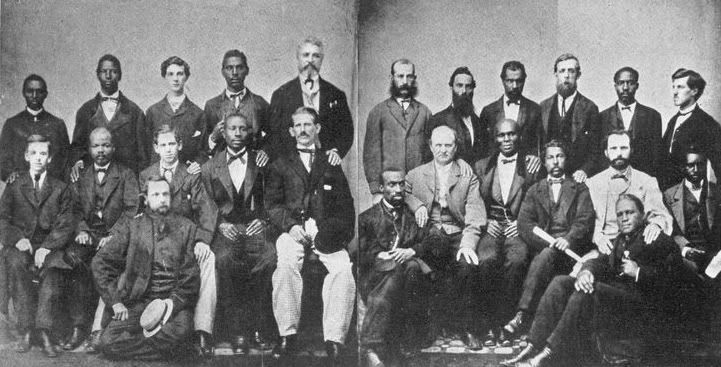
Mixed-race petit jury impaneled to try Jefferson Davis, the first mixed-race petit jury in the United States. (1867)

Monday, February 02, 2009

Apocalypse #15, America #49, Books on Books #5

But it is a great book, a very great book, the greatest book of the sea ever written. It moves awe in the soul.

The terrible fatality.

Fatality.

Doom.

Doom! Doom! Doom! Something seems to whisper it in the very dark trees of America. Doom!

Doom of what?

Doom of our white day. We are doomed, doomed. And the doom is in America. The doom of our white day.

Ah, well, if my day is doomed, and I am doomed with my day, it is something greater than I which dooms me, so I accept my doom as a sign of the greatness which is more than I am.

Melville knew. He knew his race was doomed. His white soul, doomed. His great white epoch doomed. Himself, doomed. The idealist, doomed: The spirit, doomed.

The reversion. 'Not so much bound to any haven ahead, as rushing from all havens astern.'

That great horror of ours! It is our civilization rushing from all havens astern.

The last ghastly hunt. The White Whale.

What then is Moby Dick? He is the deepest blood-being of the white race; he is our deepest blood-nature.

And he is hunted, hunted, hunted by the maniacal fanaticism of our white mental consciousness. We want to hunt him down. To subject him to our will. And in this maniacal conscious hunt of ourselves we get dark races and pale to help us, red, yellow, and black, east and west, Quaker and fireworshipper, we get them all to help us in this ghastly maniacal hunt which is our doom and our suicide.

The last phallic being of the white man. Hunted into the death of upper consciousness and the ideal will. Our blood- self subjected to our will. Our blood-consciousness sapped by a parasitic mental or ideal consciousness.

Hot blooded sea-born Moby Dick. Hunted maniacs of the idea.

Oh God, oh God, what next, when the Pequod has sunk?

She sank in the war, and we are all flotsam.

Now what next?

Who knows ? Quien sabe? Quien sabe, senor?

Neither Spanish nor Saxon America has any answer.

The Pequod went down. And the Pequod was the ship of the white American soul. She sank, taking with her negro and Indian and Polynesian, Asiatic and Quaker and good, business- like Yankees and Ishmael: she sank all the lot of them.

Boom! as Vachel Lindsay would say.

To use the words of Jesus, IT IS FINISHED.

Consummatum est! But Moby Dick was first published in 1851. If the Great White Whale sank the ship of the Great White Soul in 1851, what's been happening ever since?

Post-mortem effects, presumably.

Because, in the first centuries, Jesus was Cetus, the Whale. And the Christians were the little fishes. Jesus, the Redeemer, was Cetus, Leviathan. And all the Christians all his little fishes.


D.H. Lawrence, Studies in Classic American Literature (1923)

Monday, January 19, 2009

Scenes from a Life #21, America #48


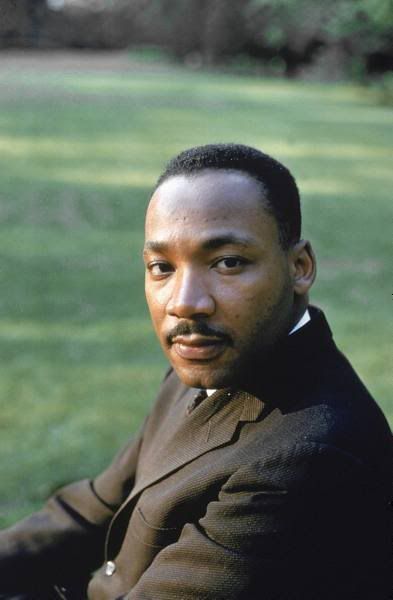
Dr. Martin Luther King, Jr.

Tuesday, December 09, 2008

America #47

Small islands not capable of protecting themselves, are the proper objects for kingdoms to take under their care; but there is something very absurd, in supposing a continent to be perpetually governed by an island. In no instance hath nature made the satellite larger than its primary planet, and as England and America, with respect to each other, reverses the common order of nature, it is evident they belong to different systems. England to Europe: America to itself.

Thomas Paine, Common Sense (1776)

Thursday, November 06, 2008

America #46

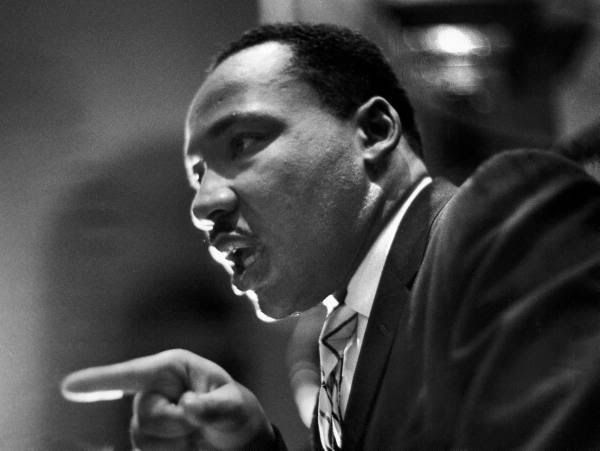
And these are the things we must be concerned about—we must be concerned about because we love America and we are out to free not only the Negro. This is not our struggle today to free 17,000,000 Negroes. It’s bigger than that. We are seeking to free the soul of America. Segregation debilitates the white man as well as the Negro. We are to free all men, all races, and all groups. This is our responsibility and this is our challenge and we look to this great new state in our Union as an example and as the inspiration. As we move on in this realm, let us move on with the faith that this problem can be solved and that it will be solved, believing firmly that all reality hinges on moral foundations and we are struggling for what is right and we are destined to win.

Martin Luther King, Jr., Address to the House of Representatives of the First Legislature, State of Hawaii (September 23, 1959)

Monday, November 03, 2008

America #45

America is, therefore the land of the future, where, in the ages that lie before us, the burden of the World’s history shall reveal itself.

Georg Wilhelm Friedrich Hegel, The Philosophy of History, introduction (1832)

Tuesday, October 28, 2008

Architecture #34, America #44

Frank Lloyd Wright was, very probably, the last of the true Americans. This is not intended to suggest that he was of Red Indian origin (which he wasn’t) or that his ancestors came over on the Mayflower (which they didn’t). It is intended to mean that Wright was the last great representative of all the things this country once stood for in the world when “America” was still a radical concept, rather than a settled continent: a symbol of absolute, untrammeled freedom for every individual, of as little government as possible, the end of classes and castes, of unlimited and equal physical opportunities for the adventurous, of the absence of all prejudice—excepting prejudices in favor of anything new and bold; of the absence of form and of formality, and finally, a symbol of a society of many individuals living as individuals in individual settlements—not a society of masses living in giant cities.

Peter Blake, The Master Builders: Le Corbusier, Mies van der Rohe, Frank Lloyd Wright (1970)

Thursday, October 02, 2008

Opening Lines #5, America #43, Order of the Universe #15

Once, from eastern ocean to western ocean, the land stretched away without names. Nameless headlands split the surf; nameless lakes reflected nameless mountains; and nameless rivers flowed through nameless valleys into nameless bays.

George R. Stewart, Names on the Land: A Historical Account of Place-Naming in the United States (1945)

Wednesday, September 03, 2008

America #42

Given an old culture in ruins, and a new culture in vacuo, this externalizing of interest, this ruthless exploitation of the physical environment was, it would seem, inevitable. Protestantism, science, invention, political democracy, all of these institutions denied the old value; all of them, by denial or by precept or by actual absorption, further the new activities. Thus in America the new order of Europe came quickly into being. If the nineteenth century found us more raw and rude, it was not because we had settled in a new territory; it was rather because our minds were not buoyed up by all those memorials of a great past that floated over the surface of Europe—a movement carried on by people incapable of sharing or continuing a past. It was to America that the outcast European turned, without a Moses to guide them, to wander in the wilderness; and here they have remained in exile, not without an occasional glimpse, perhaps, of the promised land.

Lewis Mumford, “The Origin of the American Mind” in The Golden Day: A Study in American Experience and Culture (1926)

Thursday, August 28, 2008

Anniverseries #9, America #41, Dead Presidents #41


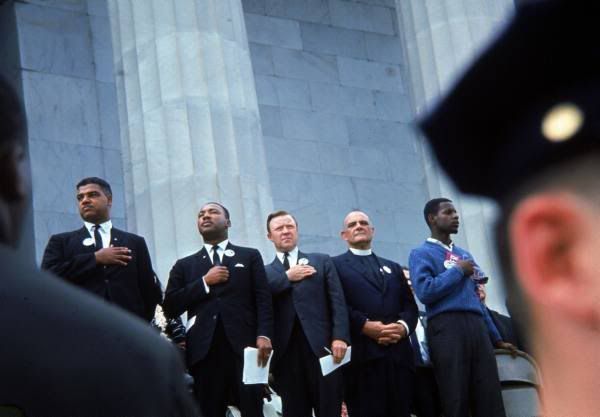
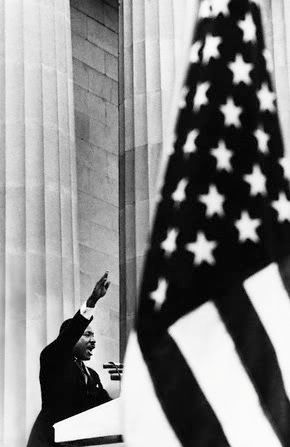
Martin Luther King, Jr. delivers the "I Have a Dream" speech on the steps of the Lincoln Memorial, Washington, D.C. (August 28, 1963)

Friday, May 30, 2008

America #40, Annals of Advertising #7, Foreign Lands #26, Food #11


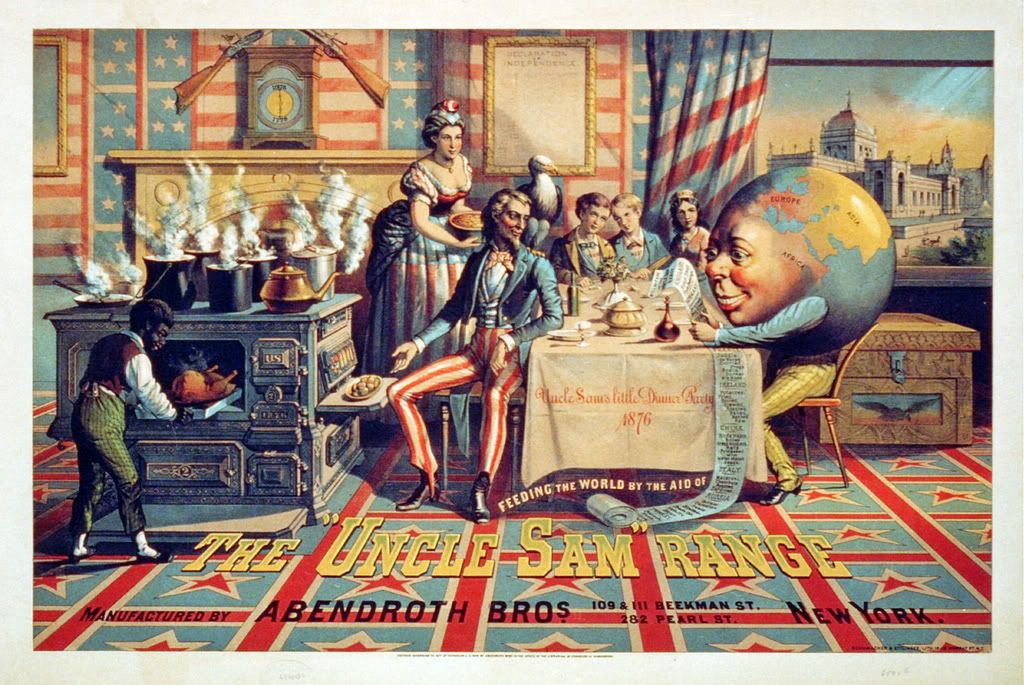
Advertisement for the "Uncle Sam" Range, Manufactured by Abendroth Bros., New York City (1876)

The menu in the world's hand reads:

BILL OF FARE
For the Uncle Sam Range.

ENGLAND
Roast Beef
Plum Pudding

GERMANY
Sausages
[illegible]
Sour Cream

FRANCE
Saddle de Horse
Curried Frogs
Snails
Donkey a la Mode

IRELAND
Potatoes
Fried
Boiled
Stewed
Roasted
Baked
Mashed
Raw

CHINA
Birds Nests
Boiled Grasshoppers
Rats Fricassed with Watermelon Seeds

RUSSIA
Tallow
Candles
Seals Blubber
Train Oil
White Bear

Sunday, May 18, 2008

Art #16, Dead Presidents #39, America #39

The artist, however faithful to his personal vision of reality, becomes the last champion of the individual mind and sensibility against an intrusive society and an officious state. The great artist is thus a solitary figure. He has, as Frost said, a lover's quarrel with the world. In pursuing his perceptions of reality, he must often sail against the currents of his time. This is not a popular role. If Robert Frost was much honored in his lifetime, it was because a good many preferred to ignore his darker truths. Yet in retrospect, we see how the artist's fidelity has strengthened the fibre of our national life.

If sometimes our great artists have been the most critical of our society, it is because their sensitivity and their concern for justice, which must motivate any true artist, makes him aware that our Nation falls short of its highest potential. I see little of more importance to the future of our country and our civilization than full recognition of the place of the artist.

If art is to nourish the roots of our culture, society must set the artist free to follow his vision wherever it takes him. We must never forget that art is not a form of propaganda; it is a form of truth. And as Mr. MacLeish once remarked of poets, there is nothing worse for our trade than to be in style. In free society art is not a weapon and it does not belong to the spheres of polemic and ideology. Artists are not engineers of the soul. It may be different elsewhere. But democratic society—in it, the highest duty of the writer, the composer, the artist is to remain true to himself and to let the chips fall where they may. In serving his vision of the truth, the artist best serves his nation. And the nation which disdains the mission of art invites the fate of Robert Frost's hired man, the fate of having "nothing to look backward to with pride, and nothing to look forward to with hope."

John F. Kennedy, Remarks at Amherst College in memory of Robert Frost (October 26, 1963)

Tuesday, May 06, 2008

Cinema #37, War #9, Scopitone #32, America #38


"Remember My Forgotten Man" Gold Diggers of 1933 (d. Mervyn LeRoy/Busby Berkeley)

Monday, April 28, 2008

America #37

Today Europeans have begun to dress for the eye, American-style, just at the moment when Americans have begun to abandon their traditional visual style. The media analyst knows why these opposite styles suddenly transfer their locations. The European, since the Second War, has begun to stress visual values; his economy, not coincidentally, now supports a large amount of uniform consumer goods. Americans, on the other hand, have begun to rebel against uniform consumer values for the first time. In cars, in clothes, in paperback books; in beards, babies, and beehive hairdos, the American has declared for stress on touch, on participation, involvement, and sculptural values. America, once the land of an abstractly visual order, is profoundly "in touch" again with European traditions of food and life and art. What was an avant-garde program for the 1924 expatriates is now the teenagers' norm.

Marshall McLuhan, "Clothing," Understanding Media: The Extensions of Man (1964)

Wednesday, April 09, 2008

America #36, Foreign Lands #25

La culture américaine en tant que distincte de la nôtre, comme l'est la culture chinoise, est une invention pure et simple des Européens.

American culture, as distinct from our own as is Chinese culture, is purely and simply a European invention.


André Malraux, Les Conquérants