Wednesday, August 26, 2009

In Memoriam #15, America #51


Ted Kennedy


(1932-2009)

I am confident that the Democratic Party will reunite on the basis of Democratic principles, and that together we will march towards a Democratic victory in 1980.

And someday, long after this convention, long after the signs come down and the crowds stop cheering, and the bands stop playing, may it be said of our campaign that we kept the faith.

May it be said of our Party in 1980 that we found our faith again.

And may it be said of us, both in dark passages and in bright days, in the words of Tennyson that my brothers quoted and loved, and that have special meaning for me now:

I am a part of all that I have met
To [Tho] much is taken, much abides
That which we are, we are—
One equal temper of heroic hearts
Strong in will
To strive, to seek, to find, and not to yield.

For me, a few hours ago, this campaign came to an end.

For all those whose cares have been our concern, the work goes on, the cause endures, the hope still lives, and the dream shall never die.


1980 Democratic National Convention Address (August 12, 1980)


Monday, August 17, 2009

Time #19, Books on Books #6

[L]a plupart des grands auteurs contemporains, Proust, Joyce, Dos Passos, Faulkner, Gide, V. Woolf, chacun à sa manière, ont tenté de mutiler le temps. Les uns l'ont privé de passé et d'avenir pour le réduire à l'intuition pure de l'instant ; d'autres, comme Dos Passos, en font une mémoire morte et close. Proust et Faulkner l'ont simplement décapité, ils lui ont ôté son avenir, c'est-à-dire la dimension des actes et de la liberté.


Most of the great contemporary authors, Proust, Joyce, Dos Passos, Faulkner, Gide, and Virginia Woolf, have tried, each in his own way, to distort time. Some of them have deprived it of its past and future in order to reduce it to the pure intuition of the instant; others, like Dos Passos, have made of it a dead and closed memory. Proust and Faulkner have simply decapitated it. They have deprived it of its future, that is, its dimension of deeds and freedom.

Jean-Paul Sartre (1939)

Monday, August 03, 2009

Plausible Historical Analogies #1, The Animal Kingdom #15


The G.O.P. elephant shuffles off this mortal coil under the watchful eye of spectral megafauna.

The card in the brontosaurus's mouth reads, "Ancient Order of Extinct Animals. Membership Ticket."

Puck (November 27, 1912)

Friday, July 24, 2009

Cinema #44, Memory #8, Time #18

To speak—perhaps to write?—of Casablanca is like looking at an old photograph: there you are but somehow that is not you: in between there is memory, the time that went by and the renewed photofinish, its battle with time won—and lost. Time does not pass: you pass through time and as in a narrow hedge of brambles you leave your clothes and skin on the thorns too. In short, time is like the bank in roulette: it always wins. (It wins even when it loses.) And it has won against Casablanca. It that obsolete, distant, almost ridiculous and false movie the one which you so lovingly remembered? Is the petulant part of Claude Rains the perfect portrayal of a gentleman in cynic’s clothing that we treasured in our memory? And Humphrey Bogart, isn’t he a caricature of what he pretends to be, with his absurd existentialist gallantry? And isn’t Paul Henreid ridiculous as the hero of the Resistance that they oblige him to be? Instead of conspiring underground and keeping himself hidden he devotes himself to conducting the Marseillaise in front of all the Germans, like a laughable apprentice of Leopold Stokowski? And what about Conrad Veidt, with his real German accent made into a phony one by the falseness of his role as a stupid Prussian gentlemen? To the cronista’s questions, the reader can in turn ask: “So, then, why the four points (the sign of excellence), what are they for?” They are for memory.

G. Cain (a.k.a. Guillermo Cabrera Infante), “Time v. Cinema” (June 2, 1956)

Monday, July 20, 2009

Architecture #40, Cinema #43


The face of Vincent Prince superimposed over Frank Lloyd Wright's Ennis House, Los Angeles, California.

From the opening sequence of House on Haunted Hill d: William Castle (1959)

Friday, July 17, 2009

Death #6, Order of the Universe #28

All the Flowers of the Spring
Meet to perfume our burying:
These have but their growing prime,
And man does flourish but his time.
Survey our progresse from our birth,
We are set, we grow, we turne to earth.
Courts adieu, and all delights,
All bewitching appetites;
Sweetest Breath, and clearest eye,
Like perfumes goe out and dye;
And consequently this is done,
As shadowes wait upon the Sunne.
Vaine the ambition of Kings,
Who seeke by trophies and dead things,
To leave a living name behind,
And weave but nets to catch the wind.

John Webster, from The Devil's Law-Case (c. 1623)

Wednesday, July 15, 2009

Dead Presidents #47


Philippines Governor-General William Howard Taft rides a water buffalo. (c. 1903)

Thursday, July 02, 2009

Tuesday, June 30, 2009

Monumental Fictions #3, Cinema #42


San Francisco Disaster, American Mutoscope & Biograph Co.

Camera, G.W. "Billy" Bitzer, shot at the Biograph studios, New York City (May 19, 1906)

Monday, June 29, 2009

Annals of Photography #4

[T]he camera seems to me, next to unassisted and weaponless consciousness, the central instrument of our time ; and is why in turn I feel such rage at its misuse: which has so nearly universal a corruption of sight that I know of less than a dozen alive whose eyes I can trust even so much as my own.

James Agee, Let Us Now Praise Famous Men

Age of Print #16


The Novels of Dashiell Hammett, Alfred A. Knopf, publishers (1965)

Wednesday, June 24, 2009

Aphorisms #7

I live for syntax.

Raymond Chandler

Thursday, June 18, 2009

Book Titles Without Context #5

Travels of a Republican Radical in Search of Hot Water

H.G. Wells (1939)

Tuesday, June 09, 2009

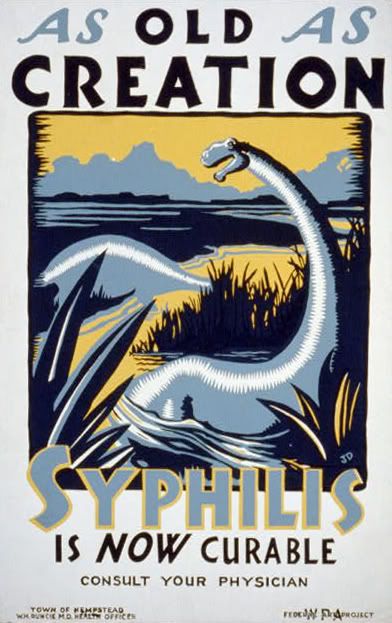
Archaeology of the Poster #8, Medicine #2, The Animal Kingdom #14


The WPA promotes treatment for syphilis through ancient saurians. (c. 1937)

Wednesday, June 03, 2009

Time #17, History #14, Order of the Universe #27

Time dissipates to shining ether the solid angularity of facts.

Ralph Waldo Emerson, “History,” Essays, First Series (1841)

Sunday, May 31, 2009

Order of the Universe #26, Music #14

Peut-être est-ce le néant qui est le vrai et tout notre rêve est-il inexistant, mais alors nous sentons qu’il faudra que ces phrases musicales, ces notions qui existent par rapport à lui, ne soient rien non plus. Nous périrons mais nous avons pour otages ces captives divines qui suivront notre chance. Et la mort avec elles a quelque chose de moins amer, de moins inglorieux, peut-être de moins probable.

Maybe it is the nothingness that is real and our entire dream is nonexistent, but in that case we feel that these phrases of music, and these notions that exist in relation to our dream, must also be nothing. We will perish, but we have for hostages these divine captives who follow and share our fate. And death in their company is less bitter, less inglorious, perhaps less probable.

Marcel Proust, Du côté de chez Swann
English translation by Lydia Davis

Friday, May 29, 2009

The Emotion is in the Emulsion #1, Dead Presidents #46


President William Howard Taft fights in vain against the physical destruction of the record of his Denver handshake.

Tuesday, May 26, 2009

Order of the Universe #25

This shining moment is an edifice
Which the Omnipotent cannot rebuild.

Ralph Waldo Emerson

Monday, May 25, 2009

Architecture #39

Architecture is a very good test of the true strength of a society, for the most valuable things in a human state are the irrevocable things—marriage, for instance. And architecture approaches nearer than any other art to being irrevocable, because it is so difficult to get rid of. You can turn a picture with its face to the wall; it would be a nuisance to turn that Roman cathedral with its face to the wall. You can tear a poem to pieces; it is only in moments of very sincere emotion that you tear a town-hall to pieces. A building is akin to dogma; it is insolent, like a dogma. Whether or no it is permanent, it claims permanence like a dogma. People ask why we have no typical architecture of the modern world, like impressionism in painting. Surely it is obviously because we have not enough dogmas; we cannot bear to see anything in the sky that is solid and enduring, anything in the sky that is solid and enduring, anything in the sky that does not change like the clouds of the sky. But along with this decision which is involved in creating a building, there goes a quite similar decision in the more delightful task of smashing one. The two of necessity go together. In few places have so many fine public buildings bee set up as here in Paris, and in few places have so many been destroyed. When people have finally got into the horrible habit of preserving buildings, they have got out of the habit of building them. And in London one mingles, as it were, one’s tears because so few are pulled down.

G.K. Chesterton, Tremendous Trifles (1909)

Thursday, May 21, 2009

Age of Print #14


Front and back covers of first American edition of The Life of Alfred Nobel. (1929)