Diptych #11, Archaeology of the Music Video #7
Peggy Lee sings "Johnny Guitar". (c. 1954)
The Spotnicks play an instrumental version of "Johnny Guitar". (1962)


Peggy Lee sings "Johnny Guitar". (c. 1954)
The Spotnicks play an instrumental version of "Johnny Guitar". (1962)
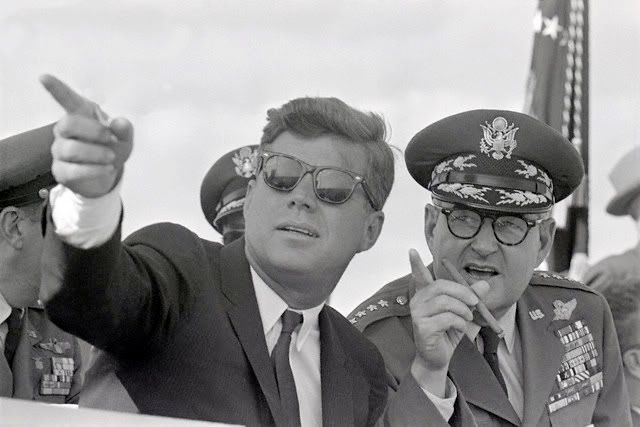
Top: President John F. Kennedy and Air Force Union of Staff General Curtis LeMay point at a fireworks display staged for the president. (May 4, 1962)
Bottom: Original caption: Swapping his Air Force uniform for a bright sport shirt, General Curtis LeMay, Head of the U. S. Strategic Air Command, sharpens his shooting eye with some target practice at the Marine Base at Quantico, Virginia. LeMay sandwiched in the shooting session during the three-day conference on Defense Matters, at the base. (June 17, 1957)
On devient cuisinier mais on naît rôtisseur.
Brillat-Savarin, Aphorism No. XV
On devient ingénieur, mais on naît architecte.
Auguste Perret, Aphorism No. I
Evel Knievel
(1938-2007)
Evel Knievel crashes at Caesar's Palace, Las Vegas, Nevada (December 31, 1967)
still from Scorpio Rising
d. Kenneth Anger (1964)

Top: President Roosevelt's Fourth of July Oration, American Mutoscope and Biograph Company, camera, G.W. "Billy" Bitzer, Kleine Optical Co. (1903)
Bottom:
Navajo Indians at Fair Grounds, July 4th celebration, Farmington, New Mexico. (c. 1901-1908)
Alphaville (1965)
J’ai cru pouvoir briser la profondeur de l’immensité
Par mon chagrin tout nu sans contact sans écho
Je me suis étendu dans ma prison aux portes vierges
Comme un mort raisonnable qui a su mourir
Un mort non couronné sinon de son néant
Je me suis étendu sur les vagues absurdes
Du poison absorbé par amour de la cendre
La solitude m’a semblé plus vive que le sang
Je voulais désunir la vie
Je voulais partager la mort avec la mort
Rendre mon cœur au vide et le vide à la vie
Tout effacer qu’il n’y ait rien ni vire ni buée
Ni rien devant ni rien derrière rien entier
J’avais éliminé le glaçon des mains jointes
J’avais éliminé l’hivernale ossature
Du voeu de vivre qui s’annule
Tu es venue le feu s'est alors ranimé
L'ombre a cédé le froid d'en bas s'est étoilé
Et la terre s'est recouverte
De ta chair claire et je me suis senti léger
Tu es venue la solitude était vaincue
J'avais un guide sur la terre je savais
Me diriger je me savais démesuré
J'avançais je gagnais de l'espace et du temps
J'allais vers toi j'allais sans fin vers la lumière
La vie avait un corps l'espoir tendait sa voile
Le sommeil ruisselait de rêves et la nuit
Promettait à l'aurore des regards confiants
Les rayons de tes bras entrouvraient le brouillard
Ta bouche était mouillée des premières rosées
Le repos ébloui remplaçait la fatigue
Et j'adorais l'amour comme à mes premiers jours.
Les champs sont labourés les usines rayonnent
Et le blé fait son nid dans une houle énorme
La moisson la vendange ont des témoins sans nombre
Rien n’est simple ni singulier
La mer est dans les yeux du ciel ou de la nuit
La forêt donne aux arbres la sécurité
Et les murs des maisons ont une peau commune
Et les routes toujours se croisent.
Les hommes sont faits pour s’entendre
Pour se comprendre pour s’aimer
Ont des enfants qui deviendront pères des hommes
Ont des enfants sans feu ni lieu
Qui réinventeront les hommes
Et la nature et leur patrie
Celle de tous les hommes
Celle de tous les temps.
Paul Eluard, "La mort, l'amour, la vie" (1951)


Top: A cross roads store, bar, juke joint, and gas station in the cotton plantation area, Melrose, Louisiana. Marion Post Wolcott, photographer
Bottom: Children in the tenement district, Brockton, Massachusetts. Jack Delano, photographer.
(1940)


Top: Norwalk Garage, Bakersfield, California, Richard Neutra architect (1947) Julius Shulman, photographer?
Bottom: Standard Station, Ed Ruscha (1966)
The ordinary brown-stone front was thus a series of pretentious shams, and with these shams miles of the streets of New York were and are composed. To live in and among them, to become inured to them, was to suffer the deprivation of taste the more pitiable for being conscious. The brown-stone front was enough to vulgarize a whole population, and in our case it came near succeeding.
Montgomery Schyler, "The Small City House in New York" Architectural Record (1899)
The neighbourhood was thought remote, and the house was built in a ghastly greenish-yellow stone that the younger architects were beginning to employ as a protest against the brownstone of which the uniform hue coated New York like a cold chocolate sauce; but the plumbing was perfect.
Edith Wharton, The Age of Innocence (1920)
Had we but World enough, and Time,
This coyness, Lady, were no crime
We would sit down and think which way
To walk and pass our long Love's Day.
Thou by the Indian Ganges side
Shouldst Rubies find: I by the Tide
Of Humber would complain. I would
Love you ten years before the Flood:
And you should, if you please, refuse
Till the Conversion of the Jews.
My vegetable Love should grow
Vaster than Empires, and more slow;
An hundred years should go to praise
Thine Eyes and on thy Forehead Gaze;
Two hundred to adore each Breast,
But thirty thousand to the rest;
An Age at least to every part,
And the last Age should show your Heart.
For, Lady, you deserve this State,
Nor would I love at lower rate.
Andrew Marvell, "To His Coy Mistress" (excerpt), first published 1681
"Love has no ending.
"I'll love you, dear, I'll love you
Till China and Africa meet,
And the river jumps over the mountain
And the salmon sing in the street,
"I'll love you till the ocean
Is folded and hung up to dry
And the seven stars go squawking
Like geese about the sky.
"The years shall run like rabbits,
For in my arms I hold
The Flower of the Ages,
And the first love of the world."
W.H. Auden, "As I Walked Out One Evening" (excerpt), 1938