Anniverseries #14, Dead Presidents #45
Abraham Lincoln, born February 12, 1809
Cast of Lincoln's face, hands, and Lincoln's suit and hat.


Abraham Lincoln, born February 12, 1809
Cast of Lincoln's face, hands, and Lincoln's suit and hat.
President John F. Kennedy and Jacqueline Kennedy arrive at Love Field, Dallas, Texas (November 22, 1963)
The World Trade Center towers under construction
Minoru Yamasaki and Associates (1966-1973, photographed October 20, 1970)
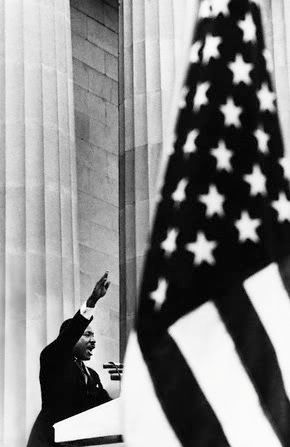
Martin Luther King, Jr. delivers the "I Have a Dream" speech on the steps of the Lincoln Memorial, Washington, D.C. (August 28, 1963)

Something is happening in Memphis; something is happening in our world. And you know, if I were standing at the beginning of time, with the possibility of taking a kind of general and panoramic view of the whole of human history up to now, and the Almighty said to me, "Martin Luther King, which age would you like to live in?" I would take my mental flight by Egypt and I would watch God's children in their magnificent trek from the dark dungeons of Egypt through, or rather across the Red Sea, through the wilderness on toward the promised land. And in spite of its magnificence, I wouldn't stop there.
I would move on by Greece and take my mind to Mount Olympus. And I would see Plato, Aristotle, Socrates, Euripides and Aristophanes assembled around the Parthenon. And I would watch them around the Parthenon as they discussed the great and eternal issues of reality. But I wouldn't stop there.
I would go on, even to the great heyday of the Roman Empire. And I would see developments around there, through various emperors and leaders. But I wouldn't stop there.
I would even come up to the day of the Renaissance, and get a quick picture of all that the Renaissance did for the cultural and aesthetic life of man. But I wouldn't stop there.
I would even go by the way that the man for whom I am named had his habitat. And I would watch Martin Luther as he tacked his ninety-five theses on the door at the church of Wittenberg. But I wouldn't stop there.
I would come on up even to 1863, and watch a vacillating President by the name of Abraham Lincoln finally come to the conclusion that he had to sign the Emancipation Proclamation. But I wouldn't stop there.
I would even come up to the early thirties, and see a man grappling with the problems of the bankruptcy of his nation. And come with an eloquent cry that we have nothing to fear but "fear itself." But I wouldn't stop there.
Strangely enough, I would turn to the Almighty, and say, "If you allow me to live just a few years in the second half of the 20th century, I will be happy."
Now that's a strange statement to make, because the world is all messed up. The nation is sick. Trouble is in the land; confusion all around. That's a strange statement. But I know, somehow, that only when it is dark enough can you see the stars. And I see God working in this period of the twentieth century in a way that men, in some strange way, are responding.
Something is happening in our world. The masses of people are rising up. And wherever they are assembled today, whether they are in Johannesburg, South Africa; Nairobi, Kenya; Accra, Ghana; New York City; Atlanta, Georgia; Jackson, Mississippi; or Memphis, Tennessee, the cry is always the same: "We want to be free."
Dr. Martin Luther King Jr.
excerpt from his final speech
"I've Been to the Mountaintop" (April 3, 1968)
Assassinated, Memphis, Tennessee (April 4, 1968)

Little Lamb, who made thee?
Dost thou know who made thee?
Gave thee life & bid thee feed,
By the stream & o'er the mead;
Gave thee clothing of delight,
Softest clothing, wooly, bright;
Gave thee such a tender voice,
Making all the vales rejoice?
Little Lamb, who made thee?
Dost thou know who made thee?
Little Lamb, I'll tell thee,
Little Lamb, I'll tell thee:
He is called by thy name,
For he calls himself a Lamb.
He is meek & he is mild;
He became a little child.
I a child & thou a lamb.
We are called by his name.
Little Lamb, God bless thee!
Little Lamb, God bless thee!
William Blake, "The Lamb," Songs of Innocence

Top: President Roosevelt's Fourth of July Oration, American Mutoscope and Biograph Company, camera, G.W. "Billy" Bitzer, Kleine Optical Co. (1903)
Bottom:
Navajo Indians at Fair Grounds, July 4th celebration, Farmington, New Mexico. (c. 1901-1908)


Wystan Hugh Auden, born February 21, 1907
For poetry makes nothing happen: it survives
In the valley of its making where executives
Would never want to tamper, flows on south
From ranches of isolation and the busy griefs,
Raw towns that we believe and die in; it survives,
A way of happening, a mouth.
Excerpt from "In Memory of W.B. Yeats"
(February 1939)
The primary function of poetry, as of all the arts, is to make us more aware of ourselves and the world around us. I do not know if such increased awareness makes us more moral or more efficient. I hope not.
I think it makes us more human, and I am quite certain it makes us more difficult to deceive, which is why, perhaps, all totalitarian theories of the State, from Plato's downwards, have deeply mistrusted the arts. They notice and say too much, and the neighbors start talking.
(1938)
Because of his visitation, we may no longer desire God as if He were lacking: our redemption is no longer a question of pursuit but of surrender to Him who is always and everywhere present.
For the Time Being: A Christmas Oratorio


"Man-on-the-Street", Dallas, Texas, December 9, 1941
John Avery Lomax, Interviewer
Edward Crane, Interviewee
John Lomax: This is Mr. Edward Crane talking. And this is John Lomax speaking at the present moment. And here is Mr. Crane before the microphone to ask him as a representative citizen of Dallas if he won't give to the American people his reactions when he heard of the Japanese aggression against this country that happened on the past Sunday morning. Mr. Crane.
Edward Crane: Well, it's difficult for me to express my language in printable language, my thoughts in printable language. When I saw what happened, I admit that while I've never had a very high opinion of the Japanese, their conduct in this particular situation has lowered them even in my estimations of them which was low enough. Frankly, I think there's only one thing for this country to do and that is we ought to realize the fact that we're in a war to the finish.
The issue raised is one where there's no place for compromise. In other words, it's a war to the death. There are two civilizations involved. Both of which cannot exist. Frankly, my view is and I include the Hun or the Germans so-called in what I have to say about the Japanese. That is, we ought to exterminate both of them. There's no place for either of those races in the world today. As I say, it started with, there is no compromise involved.
There are two civilizations or rather a civilization as I call it which represents the American and English viewpoint on one side and the Hun and the Jap on the other. It's going to be a long war, probably run six or ten years, but we ought to realize the fact there can't be any compromise and either one of two solutions is bound to follow. That is that the Hun and the Jap will go down or this country and England will go down. It's unthinkable for one minute to conceive the idea that the Hun and the Jap will prevail.
View from presidential motorcade, Main Street at Griffin Street, Dallas, Texas (November 22, 1963)