Showing posts with label The Animal Kingdom. Show all posts

Monday, August 03, 2009

Plausible Historical Analogies #1, The Animal Kingdom #15


The G.O.P. elephant shuffles off this mortal coil under the watchful eye of spectral megafauna.

The card in the brontosaurus's mouth reads, "Ancient Order of Extinct Animals. Membership Ticket."

Puck (November 27, 1912)

Tuesday, June 09, 2009

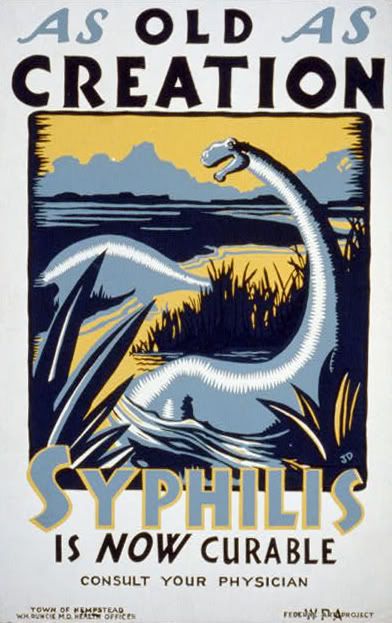
Archaeology of the Poster #8, Medicine #2, The Animal Kingdom #14


The WPA promotes treatment for syphilis through ancient saurians. (c. 1937)

Friday, March 27, 2009

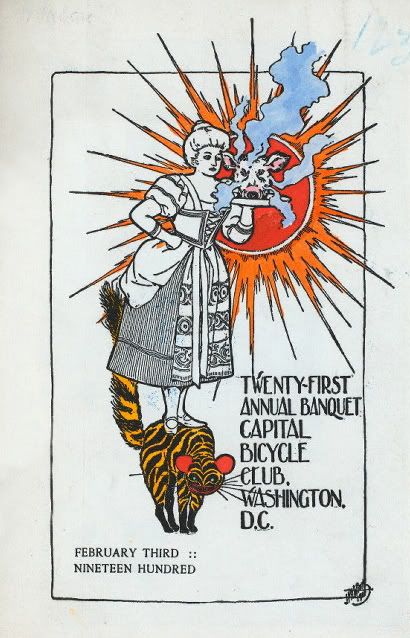
Age of Print #11, Food #13, The Animal Kingdom #13


Twenty-First Annual Capital Bicycle Club Banquet dinner menu. (February 3, 1900)

Sunday, April 27, 2008

Annals of Advertising #6, The Animal Kingdom #12


Nestlé sells milk through feline anthropomorphism. (ca. 1910)

Wednesday, March 05, 2008

The Animal Kingdom #11, Architecture #34, Age of Print #5


From Rudiments of Architecture and Building, edited by John Bullock (1865)
Illustration to Book III, Chapter IV, "Imitation of Nature and Models"

Book Titles Without Context #4, Dead Presidents #34, The Animal Kingdom #10

Turkey and the United States: How They Travel a Common Road to Ruin, Addressed by Way of Warning to President Hayes

Henry Carey Baird (1877)

Monday, February 18, 2008

Dead Presidents #32, The Animal Kingdom #9, Cinema #33


Terrible Teddy, the Grizzly King
From the Edison films catalog:
A burlesque on Theodore Roosevelt hunting mountain lions in Colorado and taken from the New York Journal and Advertiser. The scene opens in a very picturesque wood. Teddy with his large teeth is seen running down the hill with his gun in hand, followed by his photographer and press agent. He reconnoitres around a large tree and finally discovers the mountain lion. He kneels on one knee and makes a careful shot. Immediately upon the discharge of his gun a huge black cat falls from the tree and Teddy whips out his bowie knife, leaps on the cat and stabs it several times, then poses while his photographer makes a picture and the press agent writes up the thrilling adventure. A side splitting burlesque. Length 75 feet. $11.25.

[Note: the signs held by the two men read “The Press Man” and “The Photographer"]

(February 1901)

Monday, February 04, 2008

Annals of Advertising #4, The Animal Kingdom #8


Carrollton Chemical Co. advertisement (~early 1900s)

Tuesday, January 08, 2008

The Animal Kingdom #7

Invitation to Juno

Lucretius could not credit centaurs;
Such bicycle he deemed asynchronous.
"Man superannuates the horse;
Horse pulses will not gear with ours."

Johnson could see no bicycle would go;
"You bear yourself, and the machine as well."
Gennets for germans sprang from Othello,
And Ixion rides upon a single wheel.

Courage. Weren't strips of heart culture seen
Of late mating two periodicities?
Did not at one time even Darwin
Graft annual upon perennial trees?


Note: Dr. Johnson said it, somewhere in Boswell. Iago threatened Brabantio about gennets. Ixion rides on one wheel because he failed in an attempt at mixed marriage with Juno which would have produced demigods, two-wheeled because inheriting two life periods.


William Empson (from his Collected Poems)

Sunday, May 13, 2007

Dead Presidents #20, The Animal Kingdom #6


President William McKinley receives an ursine toast. (1900)

Wednesday, December 27, 2006

Saturday, December 02, 2006

The Animal Kingdom #5, Architecture #4


Lucy the Elephant, Margate, New Jersey (1881)

Saturday, November 04, 2006

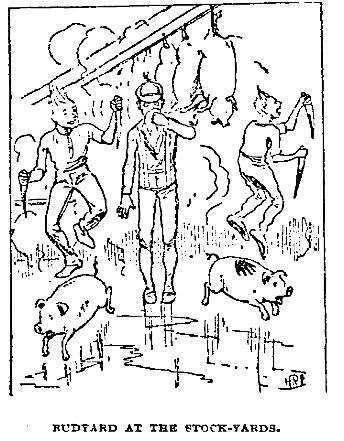
Food #7, The Animal Kingdom #4, Foreign Lands #8, The Age of Print #2


Illustration accompanying Rudyard Kipling's essay on Chicago, Chicago Tribune, Februry 8, 1891

Sunday, October 08, 2006

The Sea #3, The Animal Kingdom #2, Foreign Lands #7

Little islands are all large prisons: one cannot look at the sea without wishing for the wings of the swallow.

Sir Richard Burton, Wanderings in West Africa, 1863

Tuesday, September 26, 2006

Apocalypse #5, The Animal Kingdom #1

 "Lionesses don’t keep you from your butterflies?”
 "They seem to think it’s gone farther away. I don’t suppose it would hurt me,” Mr. Tighe said. “And even if it did—when I think of the number of butterflies I’ve caught—I should feel it was only fair. Tit for tat, you know. The brutes—if you can call a butterfly a brute—getting a little of their own back. They deserve to.”
 “In England perhaps” Anthony allowed, “but do you think altogether? […] “Haven’t the animals had it a good deal their own way on the earth?”
 The other shook his head. “Think of the great monsters,” he said. “The mammoth and the plesiosaurus and the sabre-toothed tiger. Think of what butterflies must have been once, what they are now in the jungles. But they will pass with the jungles. Man must conquer, but I should feel a sympathy with the last campaign of the brutes.”
 “I see—yes,” Anthony said. “I hadn’t thought of it like that. Do you think the animals will die out?”
 “Perhaps,” Tighe said. “When we don’t want them for transport—or for food—what will be left to them but the zoos? The birds and the moths, I suppose, will be the last to go. When all the trees are cut down.”
 “But, objected Anthony, “all the trees won’t be cut down. What about forestry and irrigation and so?’
 “O,” Mr. Tighe said, “There may be tame forests, with artificially induced butterflies. That will be only a larger kind of zoo. The real thing will have passed.”
  “And even if they do,” Anthony asked, “will man have lost anything very desirable? What after all has a lioness to show us that we cannot know without her? Isn’t all real strength to be found within us?”
 “It may be,” Mr. Tighe answered. “It may be that man will have other enemies and other joys—better perhaps. But the older ones were very lovely.”

Charles Williams, The Place of the Lion (1933)