Seasons #5
Poor, dear, silly Spring, preparing her annual surprise!
Wallace Stevens, journal entry (March 4, 1906)


Poor, dear, silly Spring, preparing her annual surprise!
Wallace Stevens, journal entry (March 4, 1906)
If speed and safety were the only considerations, there is no reason why the auto industry, once it awakened from its self-induced narcosis, should not "go with" this movement and make greater profits than ever. For it is easy to foresee the theoretic ideal limit toward which both the automotive engineer and the highway engineer have begun to move: to make the surface of this planet no better for any form of organic life than the surface of the moon. To minimize road accidents, the highway engineers have already advocated cutting down all trees and telegraph poles within a hundred feet of each side of the road. But that is only a beginning. To provide maximum safety at high speed, the car will either have to be taken out of the motorist's hands and placed under automatic control, as M.I.T. researchers have, on purely mechanical assumptions, worked out; or else turned into an armored vehicle, windowless, completely padded on the inside, with front and rear vision provided on a screen, and a television set installed to amuse the non-drivers, just as if they were in a jetplane. Along those lines, the motor car in a not-too-distant future would become a space capsule, a mobile prison, and the earth itself a featureless asteroid. Meanwhile, a further consolidation of the megamachine, with autos, jet planes, and rockets forming a single industry; the profits of that ultimate combine should exceed the wildest expectations of even General Motors.
Lewis Mumford, "The American Way of Death" (1966)
Ambulance and photographic wagon, Carson Desert, Nevada. Timothy O'Sullivan, photographer. (1867)
J.G. Ballard
(1930-2009)
From the very start, when I first turned to science fiction, I was convinced that the future was a better key to the present than the past. At the time, however, I was dissatisfied with science fiction’s obsession with its two principal themes—outer space and the far future. As much for emblematic purposes as any theoretical or programmatic ones, I christened the new terrain I wished to explore inner space, that psychological domain (manifest, for example, in surrealist painting) where the inner world of the mind and the outer world of reality meet and fuse.
Introduction to Crash (1973)
An epoch not only dreams the one to follow but, in dreaming, precipitates its awakening.
Walter Benjamin, "Paris, Capital of the Nineteenth Century. Exposé of 1935"
Cover to Dutton edition of Andrew Sarris's American Cinema: Directors and Directions 1929-1968 (1969)
Language has not the power to speak what love indites:
The soul lies buried in the ink that writes.
John Clare, fragment
NASA scientists place the golden Sounds of Earth record aboard the Voyager 1 spacecraft. (1977)
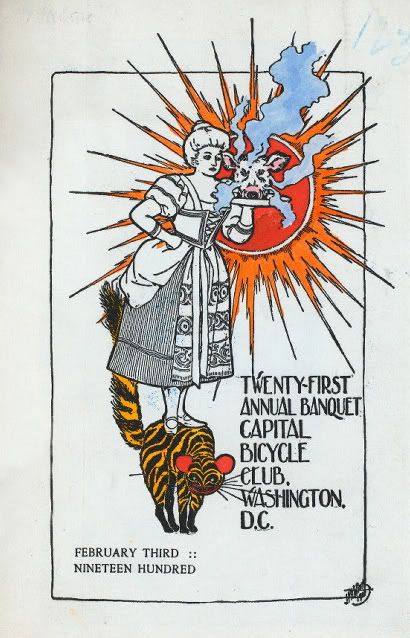
Twenty-First Annual Capital Bicycle Club Banquet dinner menu. (February 3, 1900)
To write something which was of enduring beauty, this was the ambition of every writer: as it was the ambition of the joiner and architect and the constructor of any kind. It was not the beauty but the endurance, for endurance was beautiful. It was also all that we could do. It was a consolation, even a high and positive joy, to make something true: some table, which, sat on, when it was meant only to be eaten off, would not splinter or shatter. It was not for the constructor that the beauty was made, but for the thing itself. He would triumph to know that some contribution had been made: some sort of consoling contribution quite timeless and without relation to his own profit. Sometimes we knew, half tipsy or listening to music, that at the heart of some world there lay a chord to which vibrating gave reality. With its reality there was music and truth and the permanence of good workmanship. To give birth to this, with whatever male travail, was not only all that man could do: it was also all that eclipsed humanity of either sex could do: it was the human contribution to the universe. Absolutely bludgeoned by jazz and mechanical achievement, the artist yearned to discover permanence, some life of happy permanence which he by fixing could create to the satisfaction of after-people who also looked.
T.H. White, The Goshawk (1951)
Top: Handwritten on back: "Angola, Louisiana"; "N66-1"; "N67-1."
Bottom: Handwritten on back: "Prison compund No 1. Angola, La. Leadbelly in foreground."
(Photographed c. 1934)

The present-day money pit rises from an actual pit in the ground: work on 70 Pine Street, the future headquarters (from 1976 onward) of American International Group, a.k.a. AIG.
(Pictured 1930 and 1931)
The heavens are wrath—the thunders rattling peal
Rolls like a vast volcano in the sky
Yet nothing starts the apathy I feel
Nor chills with fear eternal destiny
My soul is apathy—a ruin vast
Time cannot clear the ruined mass away
My life is hell—the hopeless die is cast
& manhoods prime is premature decay
Roll on ye wrath of thunders—peal on peal
Till worlds are ruins & myself alone
Melt heart & soul cased in obdurate steel
Till I can feel that nature is my throne
I live in love sun of undying light
& fathom my own heart for ways of good
In its pure atmosphere day without night
Smiles on the plains the forest & the flood
Smile on ye elements of earth & sky
Or frown in thunders as ye frown on me
Bid earth & its delusions pass away
But leave the mind as its creator free
John Clare, excerpts from “Written in a Thunderstorm July 15 1841”
One of the most pathetic aspects of human history is that every civilization expresses itself most pretentiously, compounds its partial and universal values most convincingly, and claims immortality for its finite existence at the very moment when the decay that leads to death has already begun.
Reinhold Niebuhr, Beyond Tragedy: Essays on the Christian Interpretation of History (1938)
Buddy Holly's body lies in front of the wreckage of the Beechcraft Bonanza B35 aircraft that also carried Ritchie Valens and the Big Bopper. (February 3, 1959)
Future zombie tower: preliminary sketches for Citicorp Center. Hugh Stubbins, architect. (1970)